
How to find the right Genius 2 use case?
Learn how to identify the right Genius 2 automation use case, assess carts and routes, and explore five examples from manufacturing and healthcare.
The challenge with flexible automation is not always finding something that can be automated. It is deciding which process should be automated first.
Genius 2 is a set of autonomous wheels that turns suitable carts, racks, bins and trolleys into autonomous mobile robots. Instead of replacing functional equipment or redesigning an entire facility, you can automate the movement of the equipment you already use.
This creates a lot of possibilities. But not every possible application is an equally good first project.
A strong Genius 2 use case is usually a frequent, predictable indoor movement of a suitable cart between known points. It should remove non-value-adding work, improve material flow and create a result you can measure.
Here is how to find one, together with five examples from manufacturing, logistics and healthcare.
Start with the movement, not the technology
Before deciding what to automate, look at how materials move through your facility today.
Where are people repeatedly pushing carts between the same locations? Which journeys take up the most time? Where do delays leave materials waiting? Which transport tasks take operators, engineers or healthcare teams away from work that needs their skills?
These movements are often the best place to start.
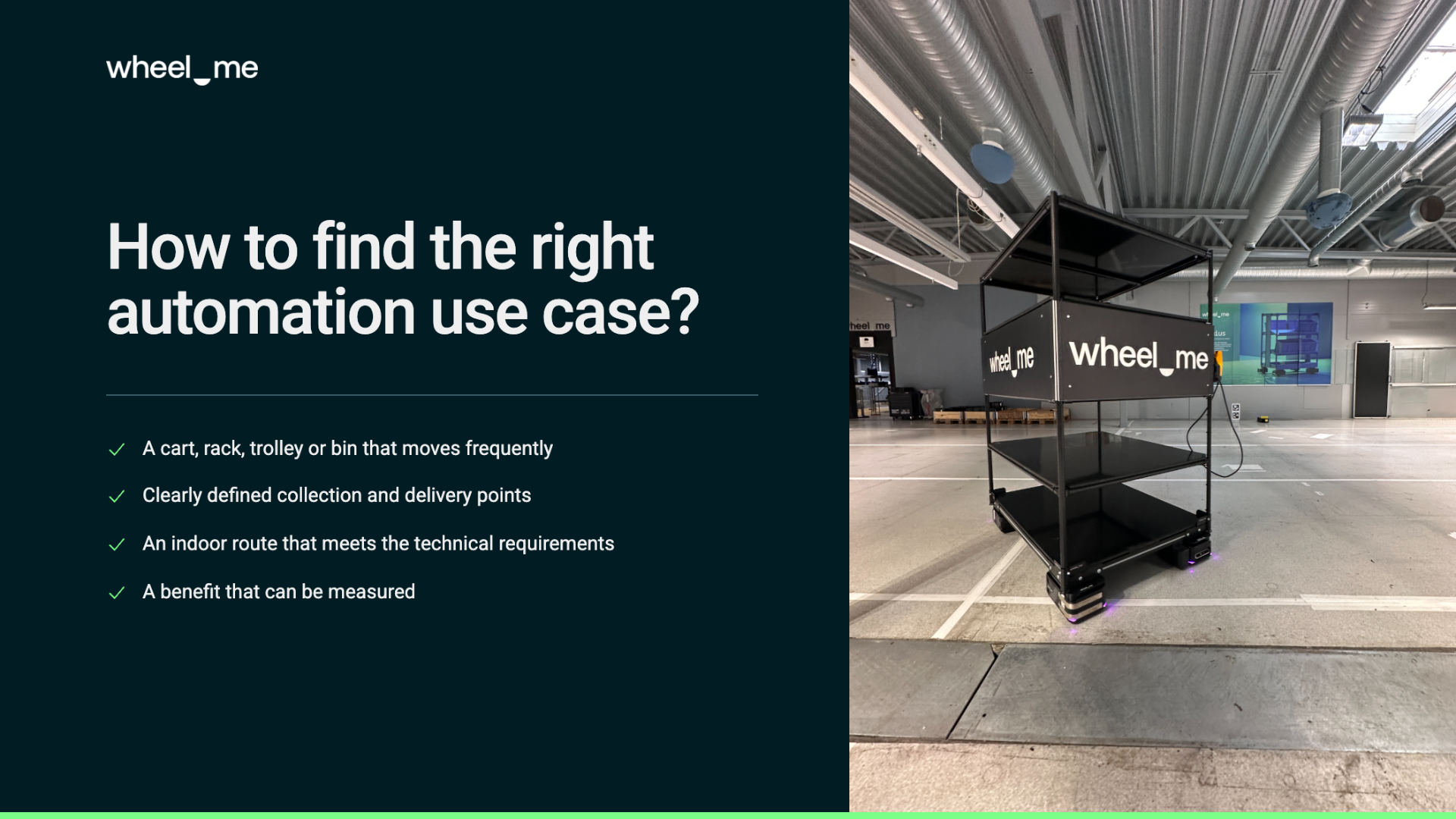
A promising Genius 2 use case will usually involve:
- A cart, rack, trolley or bin that moves frequently
- Clearly defined collection and delivery points
- A process that is repeated consistently
- Manual transport that consumes time or creates physical strain
- An indoor route that meets the technical requirements
- A benefit that can be measured
At wheel.me, we do not automate transport to replace people. We automate it to remove repetitive movement in front of them.
How often does the movement happen?
Automation creates the most value when it removes a task that happens again and again.
A cart moved once a week is unlikely to be the best place to begin. A cart moved 20, 50 or 100 times per shift is a different story.
One journey may only take a few minutes. Repeated throughout the day and across several shifts, those minutes quickly add up.
When assessing a potential use case, look at the complete process:
- How often does the cart move?
- How far does it travel?
- How many people are involved?
- What happens if the delivery is late?
- What else could those people be doing?
Closed-loop routes are often a practical starting point. The robot moves from one point to another, completes the delivery or collection, and returns ready for the next mission.
Simple processes may not look impressive on paper. They are often where automation proves its value fastest.
Are the cart, payload and route suitable?
The complete load needs to be considered, including the cart, adapters and the goods being transported.
As an initial guideline, Genius 2 applications typically require:
- A combined weight of 40–250 kg, including the cart, adapters and goods.
- A cart footprint between 50 × 70 cm and 200 × 300 cm
- Even weight distribution
- A cart that can accommodate the wheels and remain stable
These figures provide a starting point. We also assess the construction of the cart, its rigidity, centre of gravity and loading method before implementation.
The goal is not to force your equipment to fit the automation. It is to find the right way to make your equipment autonomous.
The environment matters as much as the cart.
Genius 2 is designed for indoor use on smooth, dry surfaces such as polished concrete, vinyl or terrazzo. The floor should be relatively level, with no ramps and no incline greater than three percent.
The route also needs suitable clearance, lighting and network coverage. The cameras and LiDAR must have an unobstructed field of view, and floor defects or unusual surfaces should be identified during the assessment.
One of the simplest ways to evaluate a route is to simply walk it with the cart. Look at the turns, narrow areas, crossings, doors and delivery points. Small details can make a big difference.
Can you measure the result?
Before starting a pilot, decide what you want the automation to improve.
Relevant measures might include:
- Time spent moving materials manually
- Cart movements completed per shift
- Distance walked while pushing or pulling equipment
- Waiting time at production or delivery points
- Manual handling and ergonomic risk
- Reliability of material delivery
- Time returned to operators and other teams
A clear baseline gives you something meaningful to measure against. It also makes it easier to decide whether the solution should be expanded.
Every operation is different, but the same types of material movement appear across many industries. Here are five examples.
Use Case Examples
Waste management
Internal waste transport is necessary, repetitive and often surprisingly time-consuming.
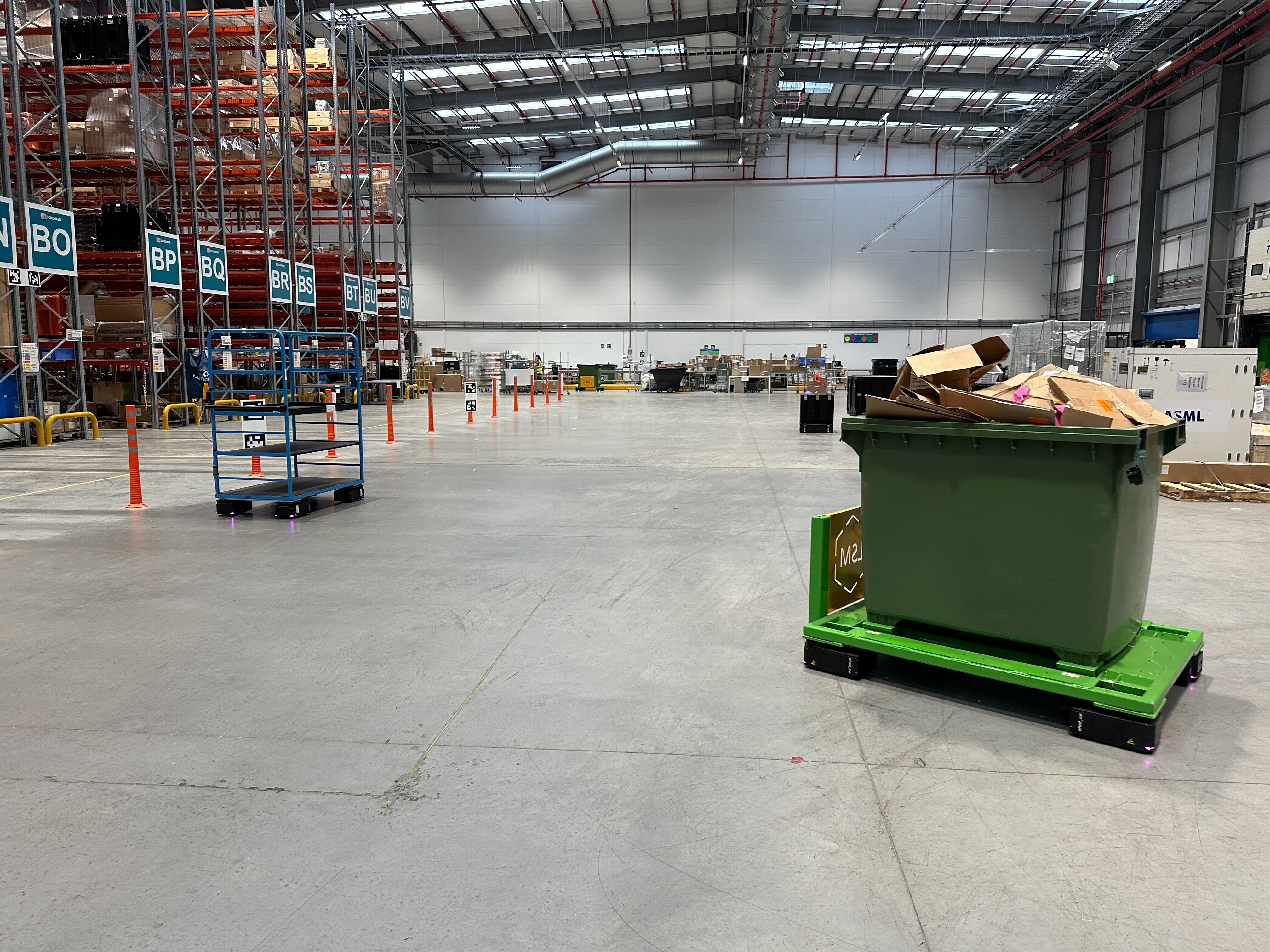
At a logistics site managed by DB Schenker, Genius wheels were added to standardized waste carts to automate movement between operational areas and the waste-handling point.
When a bin is ready, it can be transported to the designated area and returned without someone pushing it through the facility.
Why does this work well?
The route is predictable. The collection and delivery points are clear. The process happens frequently, and the time spent on it is easy to measure. If you want to learn more about the use case, read more here.
The same approach can be applied in warehouses, manufacturing plants, healthcare facilities and other sites that move internal waste regularly.
Automotive parts delivery
Automotive parts delivery presents a different challenge.
Automotive production depends on components arriving at the right workstation at the right time.
Parts such as dashboards, wiring harnesses and door panels are often moved using specialized carts. In many brownfield plants, those carts and the surrounding processes have been developed over many years.
Replacing them to accommodate automation may be expensive and disruptive.
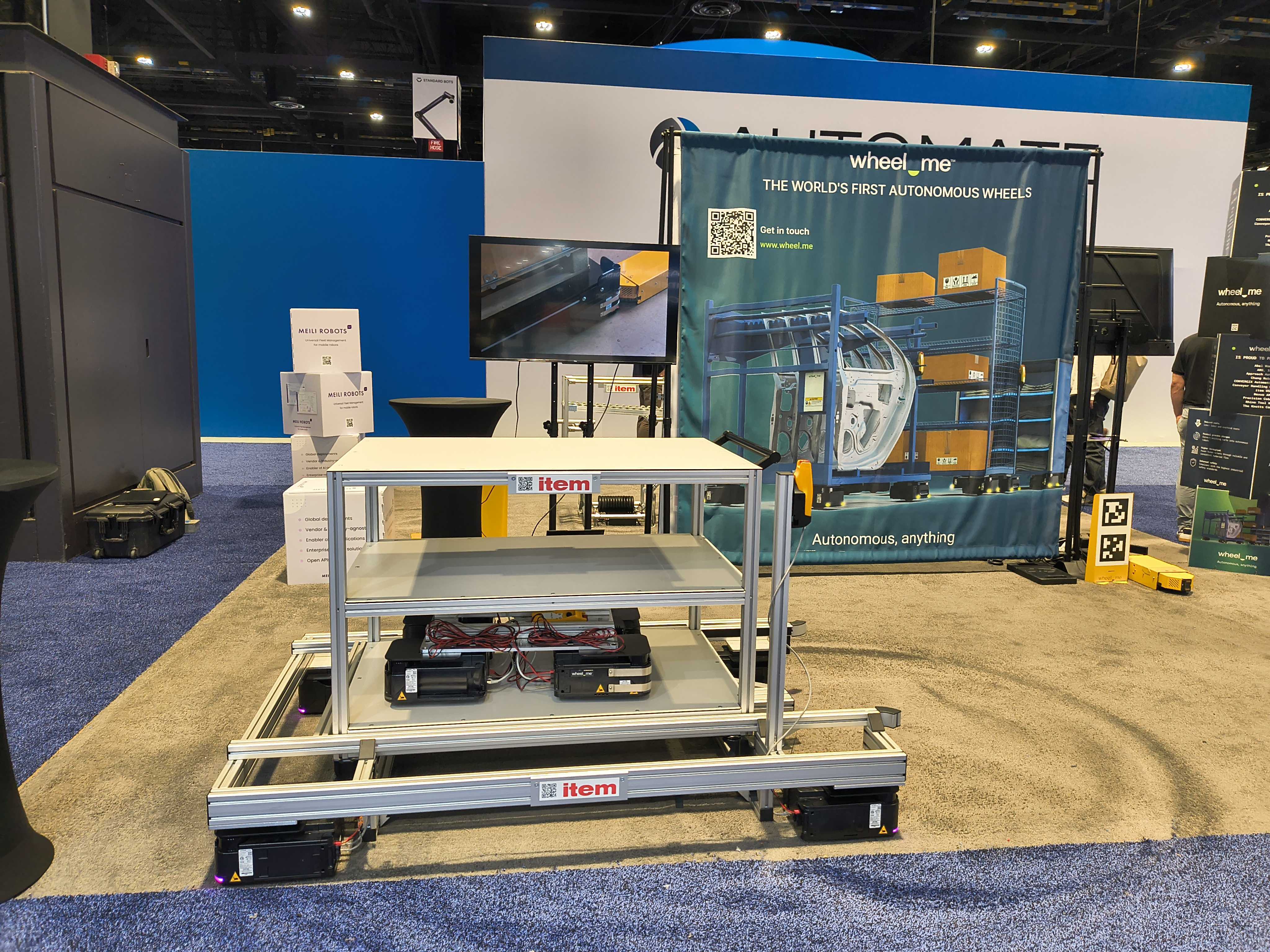
Genius 2 can be added to suitable existing carts, allowing components to move autonomously between storage, production and line-side locations. The plant keeps the equipment and workflows it already knows while automating the transport between them.
This approach is particularly relevant in facilities with limited space, varied cart designs and established production layouts.
Healthcare operations
Hospitals, nursing homes and care facilities rely on the constant movement of linen, meals, supplies and waste.
These journeys are essential, but do they need to take healthcare teams away from people?
At a nursing home in Norway, Genius wheels were added to standard laundry carts to automate linen delivery between the laundry room and resident areas. The same principle can be applied to food trolleys, supplies and other predictable back-of-house routes.
In more complex buildings, integration partners can connect Genius with elevators, automatic doors and other systems.
Essential materials keep moving. Healthcare teams get more time for human work.
Kitting carts and moving parts
Kitting cart delivery is another process built around regular, predictable material movement.
Kitting helps ensure that the correct components reach the production line together and at the right time. The carts used to deliver those kits are often moved manually along the same routes dozens or hundreds of times per day.
When they are late, the wider production flow can be affected.
Adding Genius 2 to suitable kitting carts makes it possible to automate delivery while keeping the carts and processes already used by the team on the floor.
You can begin with one predictable route. Once the process has been validated, the same approach can be extended to additional kits, production lines or delivery points.
One route becomes a practical first step towards wider material handling automation.
Taxi cart concept for high-volume operations
Taxi carts provide another option for high-volume operations.
Some facilities use too many carts to justify adding autonomous wheels to every individual unit. One Genius-powered taxi cart can instead collect and move existing passive carts between operational zones. This configuration is sometimes also called a mother-daughter system.
The facility can keep its wider cart fleet while automating transport between picking, packing, storage or production areas.
Taxi carts are particularly useful in high-throughput operations where many similar carts circulate continuously. One autonomous platform can move multiple carts, reducing the amount of hardware required and keeping standardized processes in place.
The carts do not need to adapt to the automation. The automation adapts to the carts.
How should you choose your first use case?
The best first automation project is not necessarily the biggest or most technically complex one.
It is usually a process that is frequent, easy to observe and focused enough to measure properly.
A practical use case assessment can begin with six steps:
- Observe material movements across a complete shift.
- Identify the routes repeated most frequently.
- Calculate the time, distance and human effort involved.
- Review the cart, payload and operating environment.
- Define a clear mission and measurable result.
- Start with one route before expanding.
A well-selected first use case can demonstrate value quickly and provide a practical foundation for wider automation.
The five examples above are only a starting point.
Our complete Genius use case guide includes:
- Five more applications from different industries
- Detailed examples and photographs
- A structured use case assessment process
- Requirements for carts, payloads, floors and clearance
- Sensor, lighting, environmental and network requirements
- A practical checklist for evaluating your operation
Automate what you already have. Start with the movement that makes the most sense.
Share


Learn more about autonomous wheel technology
Solutions


