
Modern Intralogistics Reaches the Classroom: Dynamotion Delivers Poland’s First wheel.me Genius 2 Implementation
For decades, Łódź was primarily associated with the textile industry. Today, it is strengthening its position as one of Poland’s leading logistics hubs. A similar transformation is taking place at one of the city’s vocational schools, once focused mainly on educating students for the textile sector and now developing programmes in logistics and freight forwarding. It is also where DYNAMOTION, wheel.me’s official integration partner in Poland, has implemented the country’s first wheel.me Genius 2 system - a project that puts Łódź at the front of autonomous logistics in Poland.
From Textiles to Logistics
Since the 19th century, Łódź has been shaped by the textile industry, with some of the largest textile factories in this part of Europe established in the city. As the sector gradually declined in importance, Łódź had to redefine its economic role. It found a new direction in logistics.
Its central location in Poland, proximity to the A1 and A2 motorways, and easy access to major metropolitan areas created favourable conditions for this transformation. Overtime, Łódź has become one of the country’s key logistics and distribution hubs, attracting major logistics operators and continued investment in warehouse infrastructure.
Education Meets Modern Intralogistics
Centrum Kształcenia Zawodowegoi Ustawicznego (CKZiU) in Łódź, a vocational and continuing education institution, is evolving alongside the city’s transformation. While maintaining its long-established heritage in textile education, the school is expanding its focus on logistics and supply chain operations through the Centrum Logistyki i Spedycji (Logistics and Freight Forwarding Centre), a project co-funded by the European Social Fund Plus.
The initiative prepares students for careers as logistics technicians, freight forwarding technicians, and warehouse logistics operators, with a strong emphasis on the skills and technologies required in today’s automated logistics and manufacturing environments.
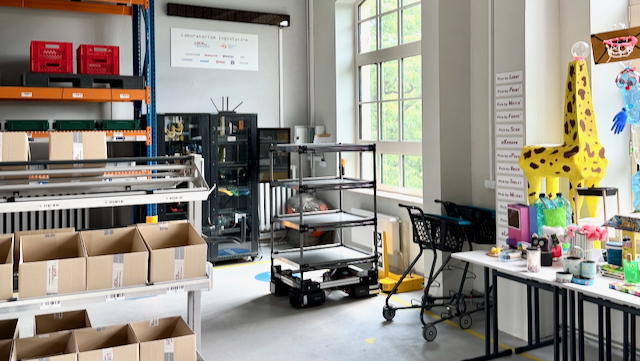
The project’s objective is to bridge the gap between education and industry by providing students with direct exposure to technologies used in modern intralogistics and material handling operations. To support this goal, CKZiU in Łódź has established a modern logistics laboratory equipped with warehouse racking systems, pick-by-light technology, and other solutions used in contemporary warehouse environments.
The laboratory’s latest addition is the wheel.me Genius 2 autonomous mobility system, representing the first implementation of this technology within a Polish educational institution. The system gives students hands-on experience with autonomous material transport, mobile robotics, and modern intralogistics processes in a real-world learning environment.
“We want our students to learn logistics through direct interaction with modern technologies rather than theory alone. With wheel.me Genius 2, they can experience how autonomous intralogistics systems operate in practice and gain valuable hands-on experience with technologies used in modern material flow processes."
Dominika Walicka, Principal of Centrum Kształcenia Zawodowego i Ustawicznego in Łódź
When a Rack Becomes a Robot
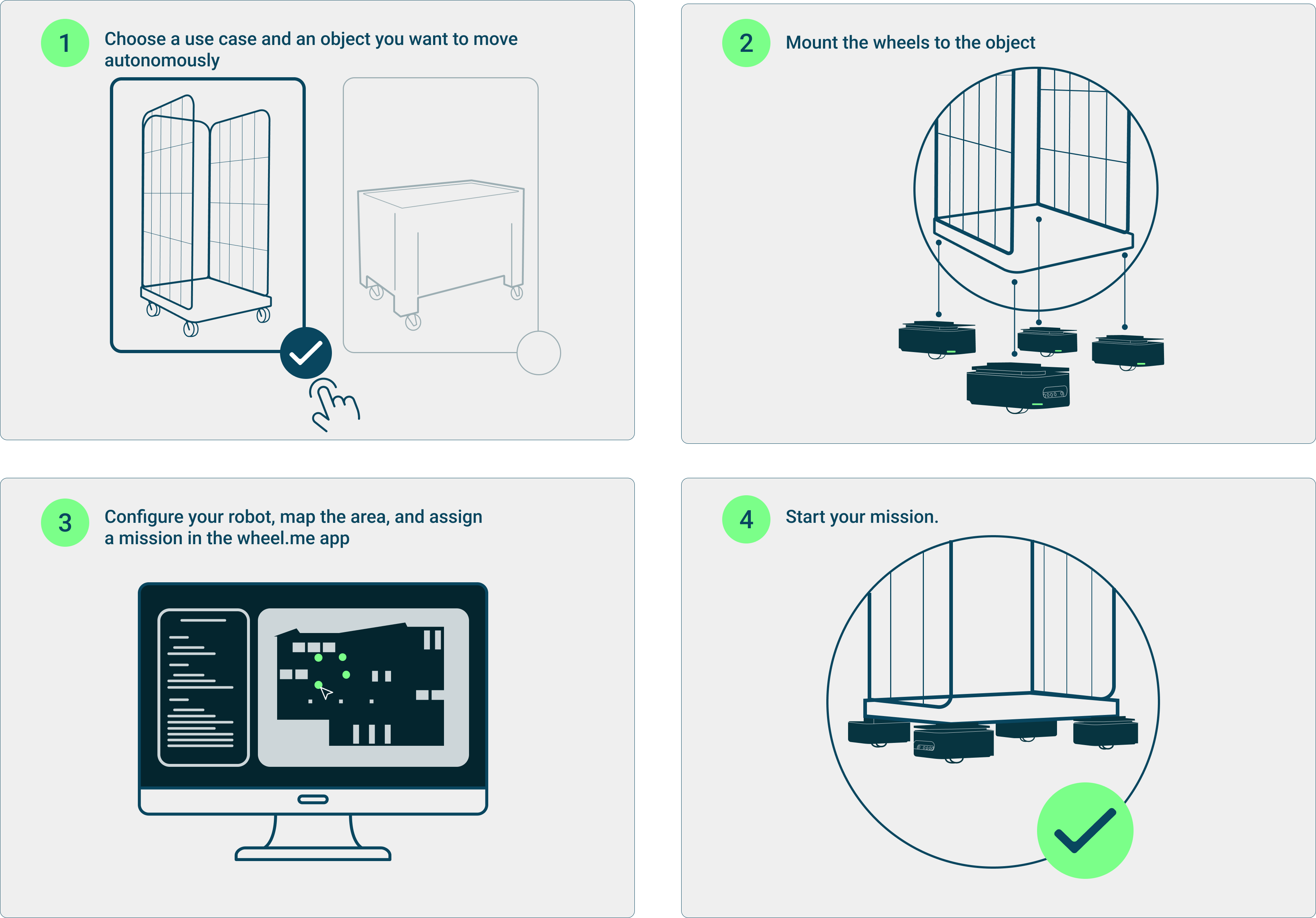
Unlike many autonomous mobile robots that come as ready-made transport platforms, wheel.me Genius 2 makes it possible to add autonomous mobility to suitable equipment that is already part of an existing process.
The system consists of four autonomous, powered wheels that can be integrated with a suitable trolley, rack, workbench, or a custom-built structure designed for a specific application.
For navigation, Genius 2 combines 2D LiDAR and camera-based perception with indoor localization to detect obstacles and navigate. This allows it to operate in spaces shared with people: personnel detection, emergency stop and braking are rated SIL 2 under IEC61508, corresponding to Performance Level D under ISO 13849-1:2023. wheel.me refers to their approach as “Autonomous Anything” - rather than imposing a single robot format, the technology adds autonomous movement to the equipment a process already uses.
How Does It Work in Practice?
In CKZiU’s logistics laboratory, Genius 2 has been integrated with a rack-based structure and performs a typical intralogistics milk-run application. The robot follows a predefined route, moving cyclically between designated points and delivering a goods rack directly to the operator.
Order picking is carried out using the pick-by-light system. In practice, instead of the operator moving between different warehouse locations, the required rack comes directly to them.
One of the key advantages of the wheel.me solution becomes particularly clear in this application: flexibility. Routes, the sequence of visited points, and picking sequences can be modified without rebuilding the surrounding infrastructure. This makes it possible to adapt the operating scenario relatively quickly and test different approaches to material flow.
In an educational environment, this gives students the opportunity to create and test various logistics scenarios independently, changing picking sequences, route configurations, or workflow layouts, and then observing how these decisions affect the overall process. Not in a simulation, but on a fully operational system.
“The greatest value of this work station is the ability to experiment with the logistics process. Students are not simply observing a ready-made solution - they can independently change operating scenarios, modify travel routes, and analyse how their decisions affect the performance of the entire process. It is hands-on automation training in a real operating environment.”
Mateusz Biega, DYNAMOTION
More Than a School Laboratory
It is not often that an educational institution, rather than a manufacturing plant or logistics centre, becomes the site of a country’s first implementation of a new robotic solution. Centrum Kształcenia Zawodowego i Ustawicznego in Łódź shows, however, that a school can do more than simply respond to changes in the market. It can also prepare students for technologies that are becoming increasingly common in modern logistics processes.
With this in mind, the first Polish implementation of Genius 2 fits naturally into the idea of creating a modern environment for logistics education - one that allows students to explore not only today’s industry standards, but also the technologies shaping the future of internal transport automation.
“Partners like DYNAMOTION are the reason projects like this happen. They know how to look at a process and find the use case where autonomous mobility genuinely makes a difference – which is exactly what they did here. We are equally glad that this came from the education sector. Schools willing to test new technology early are often where innovation starts before it reaches industry, and this project shows what education, public institutions and private companies can do when they pull in the same direction.”
Paul Olariu, Head of Regional Partnerships CEE, wheel.me
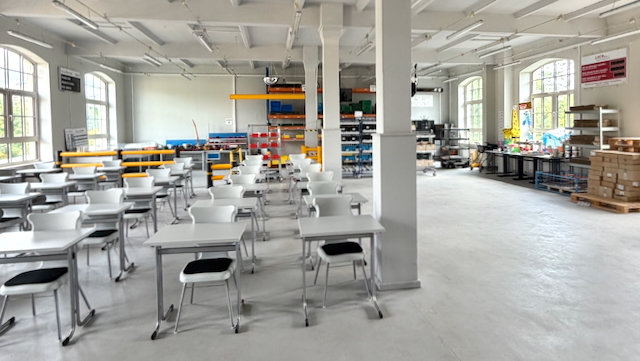
For DYNAMOTION, the official wheel.me integration partner in Poland, the project at Centrum Kształcenia Zawodowego i Ustawicznego in Łódź also highlights the versatility of Genius 2 and the broader potential of autonomous mobility in intralogistics. Although implemented in an educational setting, the solution uses technologies and workflows that closely reflect real-world intralogistics operations.
Perhaps that is the project’s greatest value: technologies that are playing an increasingly important role in modern warehouses and industrial facilities are already being introduced to the people who, in just a few years, will be responsible for designing, operating, and optimising these processes.
The same approach applies well beyond the classroom. Companies looking at their own material flow can work with DYNAMOTION to assess suitable indoor closed-loop or multi-stop use cases and integrate Genius 2 with the equipment already in the process.
Share


Learn more about autonomous wheel technology
Solutions


